

If weight loss has felt harder than it should, you are not alone.
Many people have been told the answer is simply to eat less and move more. But in real life, metabolism is more complex than that.
Inside what I call the “Inner Clinic“, your gut, brain, pancreas, hormones, blood sugar, stress response, and inflammation are all connected.
When these systems are out of balance, hunger, cravings, fatigue, and weight changes can follow. That is why this conversation is not really about willpower. It is about understanding what is happening inside the body.
Semaglutide is one tool that can support that process.
You may hear it described as a celebrity weight loss drug or a quick fix.
That is not how I think about it. I see it as a medical option that may help restore better signaling between the gut, brain, and pancreas, so the body can move toward better metabolic balance.
In a holistic practice, it is never just about the number on the scale. It is about helping your inner health support your outer well-being too.

How it works in your body
In medical terms, semaglutide is a GLP-1 receptor agonist.
In simpler language, it acts like a hormone your body already makes naturally. That hormone is called GLP-1, and it is released from the gut after you eat.
Its job is to help the body respond to food in a calm, organized way. It sends signals to the brain, the stomach, and the pancreas to help regulate hunger, fullness, and blood sugar.
For some people, especially after long periods of stress, poor sleep, insulin resistance, or years of eating on the go, these signals may not work as smoothly as they should. You may feel hungry soon after eating, think about food all day, or struggle with energy crashes.
Semaglutide helps strengthen those signals. It does not create a whole new system. It works with pathways your body already has, helping them function more effectively and for longer.
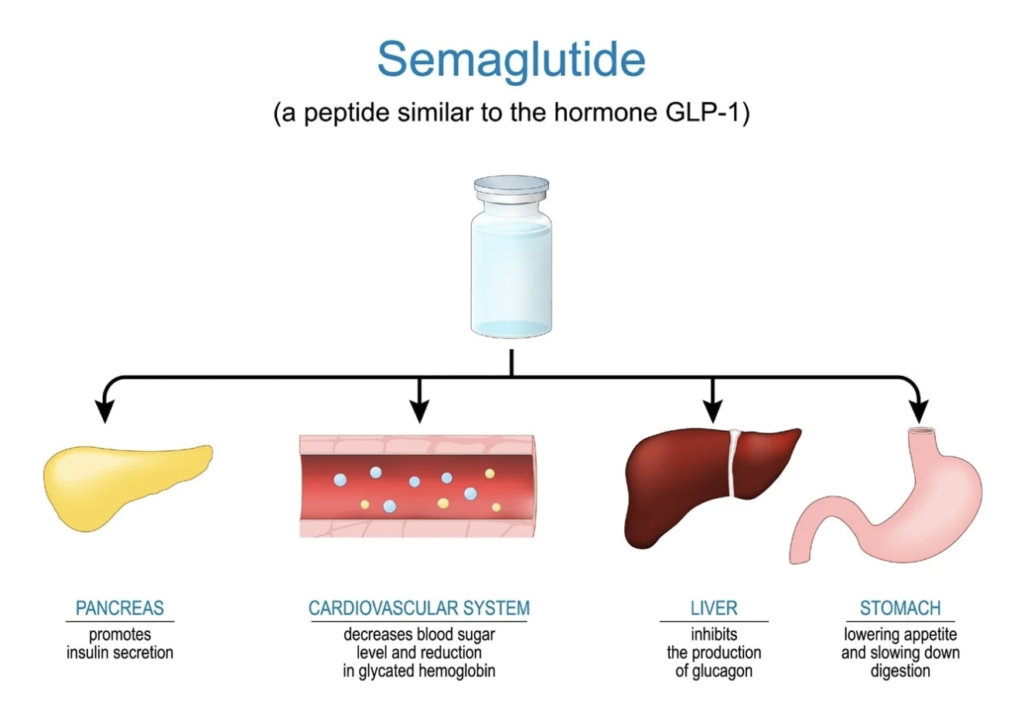
What semaglutide affects
Semaglutide works in several places at the same time, which is one reason it can be so helpful for the right person.
1. The brain
Semaglutide affects appetite centers in the brain, including areas involved in hunger and fullness. Many people notice less food noise, meaning fewer repetitive thoughts about food, snacking, or cravings.
This is not about forcing yourself to have more discipline. Often, it is about finally feeling that your brain is receiving clearer signals that you have eaten enough.
2. The gut and stomach
Semaglutide slows how quickly food leaves the stomach. This is called slower gastric emptying.
When that process is a little slower, you may feel full longer after meals. For some people, this helps reduce overeating and can make blood sugar feel more stable throughout the day.
3. The pancreas and blood sugar system
Semaglutide also helps the pancreas respond more appropriately when blood sugar rises after eating. It supports insulin release when needed and helps reduce excess glucagon signaling, which can otherwise raise blood sugar.
This matters because blood sugar swings can affect much more than weight. They can also influence energy, mood, cravings, focus, and long-term metabolic health.
When we support these inner pathways, we are not just talking about appearance. We are supporting our “Inner Clinic” so that Inner Beauty (that sense of vitality, steadiness, and health from within) has a chance to grow.
Why we look at the root cause
In my practice, I always want to understand WHY the body is struggling before jumping to a solution.
For many people, weight gain, fatigue, and ongoing cravings are connected to insulin resistance.
This means the body is making insulin, but the cells are not responding as well as they should. As a result, blood sugar stays higher, the body may store more energy as fat, and you may feel tired even after eating.
This is one reason semaglutide can be helpful. By improving communication between the gut, brain, and pancreas, it may help the body handle hunger and blood sugar in a steadier way.
But semaglutide is not the whole story.
In a root-cause, holistic approach, we also look at sleep, stress, nutrition, muscle mass, inflammation, gut health, and daily habits. The goal is not simply weight loss.
The goal is to help your “Inner Clinic” function better so your body feels more balanced, energized, and well from the inside out.
What to consider before starting
Like any medication, semaglutide can have side effects.
Some people notice nausea, constipation, bloating, or fatigue, especially in the beginning.
This is often related to how it changes digestion and appetite signaling. That is why medical guidance matters.
Semaglutide should be used thoughtfully, with attention to your full health picture.
In a holistic plan, we should not look at the medication alone.
We should look at our biomarkers, nutrition, muscle-supporting movement, gut health, sleep, and stress patterns, so it can help us decide whether semaglutide fits our specific needs and whether there may be deeper root issues affecting our metabolism.
The goal is not just to be thinner.
The goal is better metabolic flexibility – helping your body use energy more efficiently, maintain steadier blood sugar, and support a more balanced mood and appetite.
When your internal systems are working better together, you can often feel the difference in everyday life.
Semaglutide may be one helpful part of that process, especially when it is used within a thoughtful, root-cause approach to health.
Scientific references
- Wilding JPH, Batterham RL, Calanna S, et al. Once-Weekly Semaglutide in Adults with Overweight or Obesity. New England Journal of Medicine. 2021;384(11):989-1002.
- Rubino D, Abrahamsson N, Davies M, et al. Effect of Continued Weekly Subcutaneous Semaglutide vs Placebo on Weight Loss Maintenance in Adults With Overweight or Obesity. JAMA. 2021;325(14):1414-1425.
- Kushner RF, Calanna S, Davies M, et al. Clinical Impact of Semaglutide, a Glucagon-Like Peptide-1 Receptor Agonist, on Obesity Management: A Review. Advances in Therapy. 2022;39(6):2594-2622. Available via PMC: https://pmc.ncbi.nlm.nih.gov/articles/PMC9357557/
- Stanford FC, Alfaris N, Gomez G, et al. Semaglutide for the Treatment of Obesity. Trends in Cardiovascular Medicine. 2022. Available via PMC: https://pmc.ncbi.nlm.nih.gov/articles/PMC9209591/
- Müller TD, Finan B, Bloom SR, et al. GLP-1 physiology informs the pharmacotherapy of obesity. Molecular Metabolism. 2022;57:101351. Available via PMC: https://pmc.ncbi.nlm.nih.gov/articles/PMC8859548/
- Presset O, Mondoloni S, Le Dolley Y, et al. Exploring beyond numeric weight loss: The metabolic effects of semaglutide. Nutrition, Metabolism and Cardiovascular Diseases. 2025. PubMed: https://pubmed.ncbi.nlm.nih.gov/40107359/
- Mistry GC, Piani F, Seminerio MJ, et al. Clinical Consequences of Delayed Gastric Emptying With GLP-1 Receptor Agonists and Tirzepatide. The Journal of Clinical Endocrinology & Metabolism. 2025. Available via PMC: https://pmc.ncbi.nlm.nih.gov/articles/PMC11651700/
- Shibata H, Miyake T, Tatewaki M, et al. Glucagon-Like Peptide-1 Receptor Agonist Semaglutide Improves Eating Behavior and Glycemic Control in Japanese Obese Type 2 Diabetic Patients. Metabolites. 2022;12(2):147. MDPI: https://www.mdpi.com/2218-1989/12/2/147
- Alnefaie A, Albogami M, Alkhaldi A, et al. Spotlight on the Mechanism of Action of Semaglutide. Current Issues in Molecular Biology. 2024;46(12):872. MDPI: https://www.mdpi.com/1467-3045/46/12/872